A Trip Down Memory Lane : Sketching With Charcoal And Soft Pastels

Hey! Look! I managed Pencil Shading. I am confident that I can handle it well. May I try Charcoal now? Hehe…If that is your question “Sure! Why not!”. Charcoal sketching is very similar to pencil shading but in ways, it is also different. We use charcoal pencils or charcoal powder instead of graphite. In pictures, graphite looks a little greyish while charcoal gives a distinct black colour.

Would you like to join me down memory lane? In this post I am sharing my artworks I did years ago. Some while learning at the class and some afterwards. Soft Pastels (chalk) is also a similar medium. It has colours and is easier to handle. I couldn’t take formal training for Soft Pastels but I can decently manage with it. In fact, I really loved the medium once I started working with it. One can do much with it. Paintings with Pastels are quick and can look very realistic.
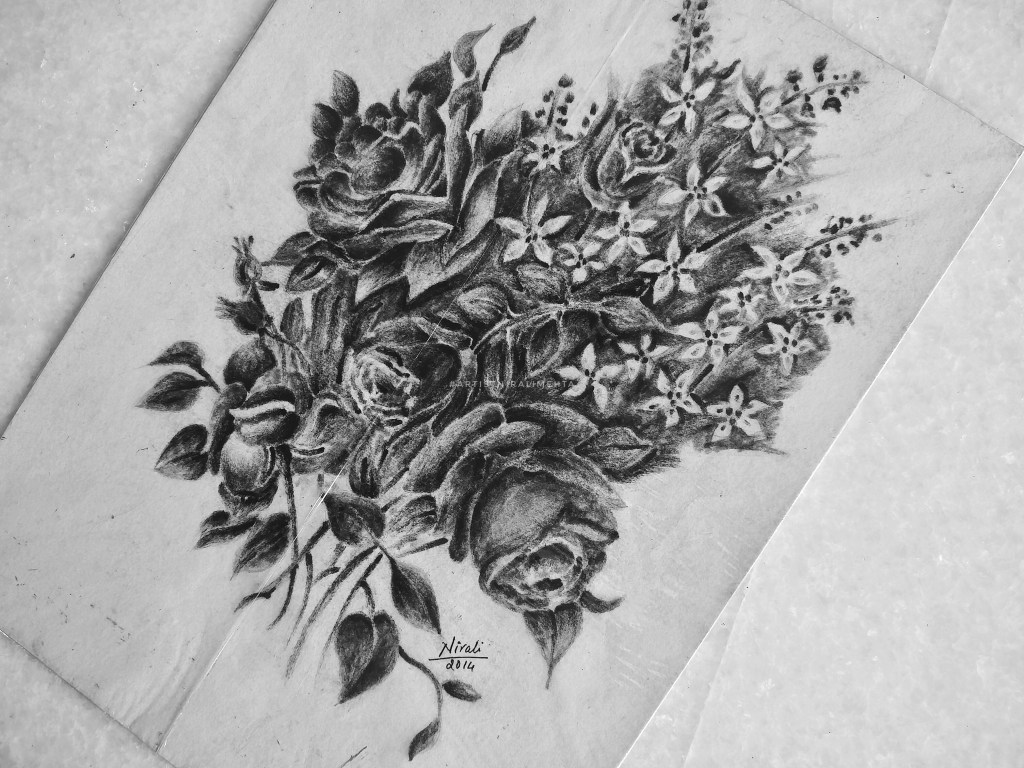
Charcoal Sketch Flowers
I started with Flowers
Charcoal Sketch Cheetah
Then tried Animals
Charcoal Horses
These are done with Stumps and Charcoal Powder
Charcoal  Sketches
Sketching Human Faces – Basic
More detailed Sketches – Portraits

Those are charcoal sticks in the picture above. They very are useful for filling darker tones in large spaces. All the pictures here above are of my artworks that I learnt and did in the class. Charcoal Sketching wasn’t exactly my strength but I enjoyed it and I think I did pretty well. Finding a good teacher is a blessing. So many can draw and paint but not all of them can teach.

Many people think pencil shading or charcoal sketching means making something exactly like that in a photograph. Please understand we are not competing against computers. Earlier when we did not have cameras people liked to have portraits and landscapes for memory. That is why artists tried to paint those pictures. That is replaced with photography. The cameras we now use are so amazing with details and precision that we need not paint the same.

Charcoal  Sketching
I think this one turned out really well

Some people edit photos and add effects to make them look like sketches or paintings. For me, if the computer can do it better, I feel it is better to let them do it. Personally, I like sketches that have a hand-drawn touch or twist to them. For my exams at the classes, we had to draw a sketch of a student sitting around: first in a pencil and then a charcoal sketch. That was my attempt at ‘live study’. I was happy I cleared the exam with pretty a good score.

Storing Charcoal Artworks can be a little tricky. The powder continues to dust off. It can spoil the other artworks stored with it. Store it in a cello envelope or sleeve. Once it is final, spray it with a fixative to fix the powder. Not only will the Artwork stay well, it won’t dust off and spoil the other papers it is kept with.

Charcoal Pencils
In the making with Charcoal Pencils
Charcoal  Sketch Girl Horse
One of my more recent works

Soft Pastels are more like chalk. They work very well for shading large surfaces. We can use the broader side as well as the pointed side. We also get Pastel Pencils for more precise finishing. More the shades in the colour box, the better for shading. Blending done with the finger works best.

Pastels on Paper
Pastels on Paper
Pastels and Charcoal Sketch
This is a mix of Pastels and Charcoal Powder

Nostalgia! I am all ready to paint with charcoals and pastels all over again. I would like to make a new artwork and see how it turns out. Would you like to give Charcoal Sketching and Soft Pastels a try? Have an Arty Weekend!

Related Posts that you may want to read :-

A Beginners Guide To Pencil Shading

Pencil shading is creating artworks using pencil strokes. I did my first artwork in pencil shading during my school days, probably in the 5th or 6th grade while preparing for my art exams. Later, after the 10th grade I took up a course in Charcoal Sketching. It was a vacation batch and as a preliminary step to Charcoal Painting my teacher took a few classes in Pencil Shading first. I learnt a lot both about Pencils and Charcoals in that class.

A pencil is the most easily available drawing tool. Learning pencil shading can teach a lot about shade and light in a drawing. Pencil Shading as a subject will be a part of every curriculum – at every Art School or University or College or a Masters level study. Traditionally ‘live study’ meaning the subject to be drawn or sketched is actually in front of you and you have to draw it was the way to sketching in Art.

It would be a good idea to invest and buy a few books on Pencil Shading and Sketching. It will be helpful to observe works by different artists and study their styles. We can practice and draw from the drawings in books. One can draw from photographs or online drawings at a later stage. Beginning from a book or with a tutor guides us stepwise and covers all the subtopics. Artists who wish to take up Pencils as their main medium of Art require training of an advanced level.

Begin with simple ‘Landscapes’ to more complex ones, followed by ‘Object Drawing’ and ‘Nature Drawing’ and finally to ‘Human sketches’ and ‘Portraits’. That is how I did them. Drawing and sketching always helps and is important even if you take up any other medium. I really think everyone can draw and everyone’s drawing will look different.

Here’s how I learnt it or what I learnt about Pencil Shading:-

  • To start with, select a simple single subject like a flower or leaf or a pot or a pan. (Picture 5)
  • For the first one, try to shade using only the 2B pencil. Observe the strokes, texture and blending (Pictures 1 and 2)
  • Add darker tones with 4B and 6B pencils (Picture 3)
  • Can blend using the finger, stumps or cotton buds (Picture 4)
  • Use a kneaded eraser. It helps erase a clean line when pointed and used. If you just tap it on the shaded area it will absorb the graphite like a magnet making the shaded area lighter but keeping the strokes. That is why I call it a magic eraser. (See pictures 6 to 8)
Learning Pencil Shading
Pencil Shading Explained

A beginner can start by looking at artworks and reference images in drawing books. I wouldn’t advise looking at images on the Internet because sometimes they are a bit too much for a novice. One can barely differentiate between a hand-drawn and digital artwork. Some of these are genuinely handmade artworks by professional artists, while some are computer edits. Don’t be disheartened looking at them or set the benchmark too high. That is why I suggest books or taking up formal training.

Learning  pencil shading  2
The strokes will improve with time. See bottom images and top images.

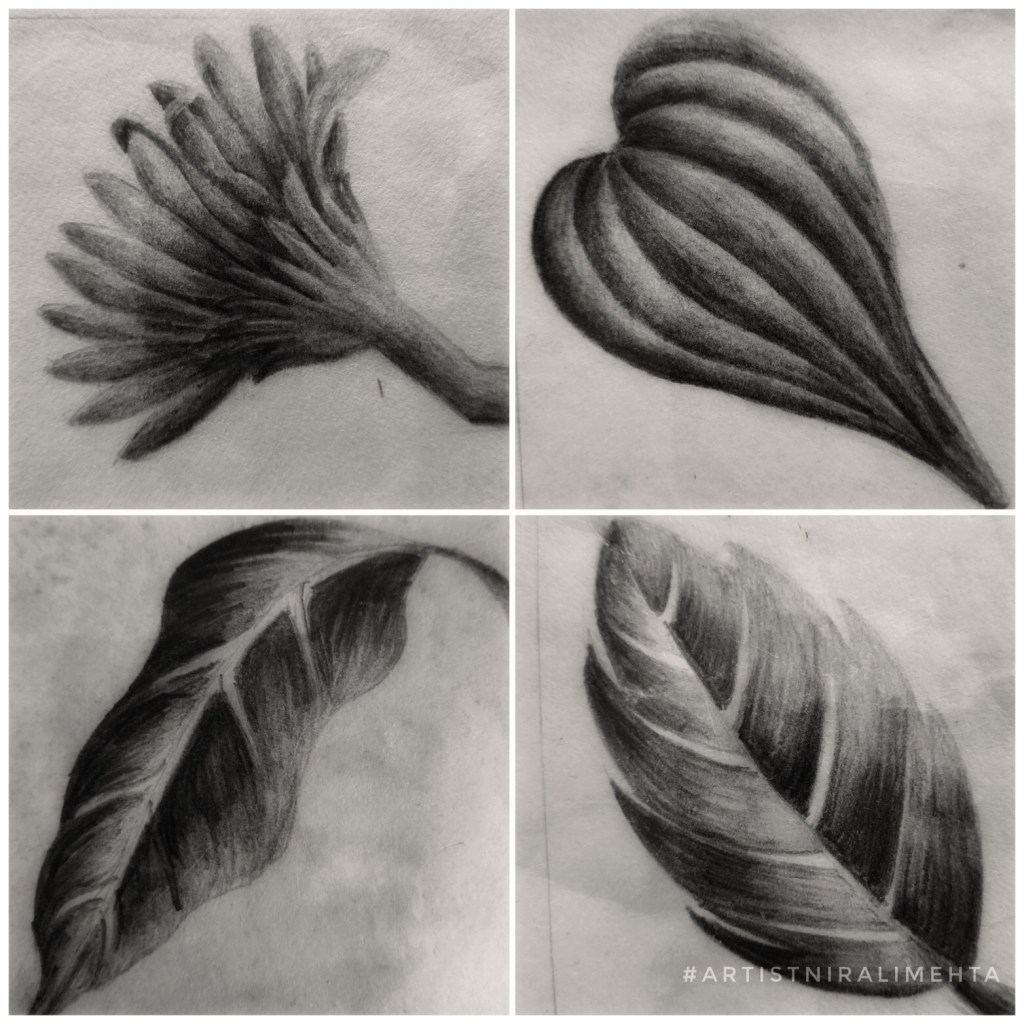
Pencil shading is the foundation to a lot of methods in drawing and painting. Once this is aced, the other methods become easier to learn. With time and practice the shading will improve. Like in this picture the leaves in the bottom images are my previous works and then with time it improved as the top two images. All the four are from my early days of learning pencil shading. Then as we feel more confident, we can take up advance levels.

I felt sharing my experience might help beginners taking up Pencil Shading. One can use Coloured Pencils for colouring as well. I have seen artists doing realistic colouring using coloured pencils. One small but important point that I would like to make here is ; with the advent of such amazing digital tools for drawing, even the best artists can get fooled as to whether the art is hand-drawn painted or digital. So please be honest with yourself and learn it without using the digital tools.

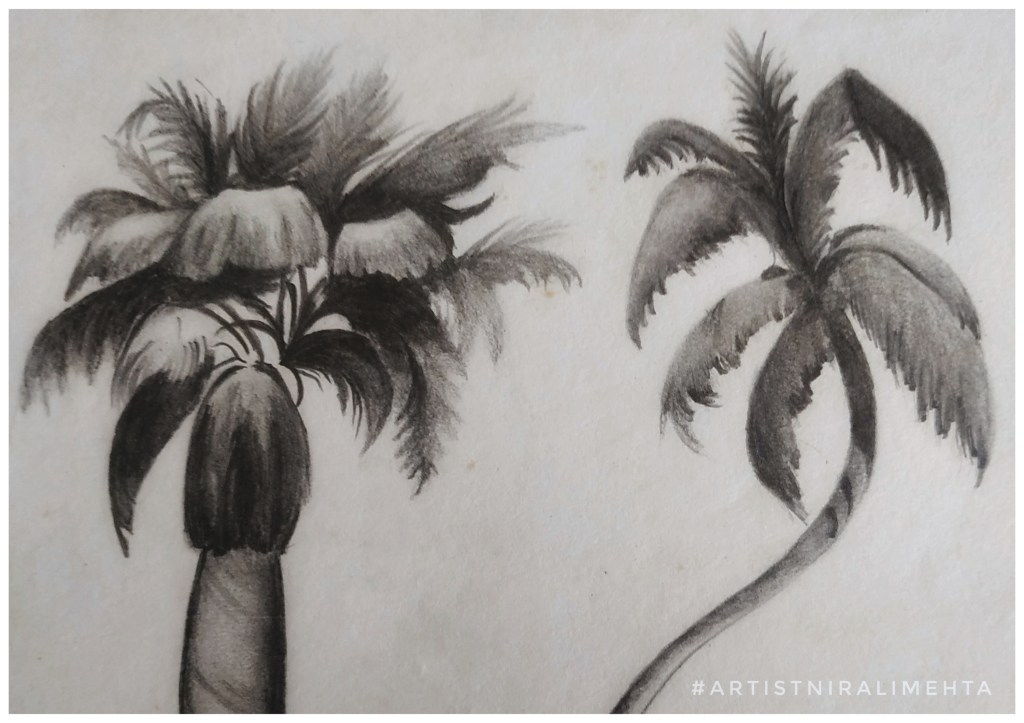
Pencil Shading Trees
Trees done in Pencil Shading

There are some additional things one needs to know about Pencil Shading. Knowing these can sort out some problems that may pop up while learning :-

1) Create strokes or lines to shade in the direction of the object surface. Rounded for the pot. The direction shows the rounded ness of the object. (Picture 9 and10) Some people create bold strokes in pencil shading like this but they should be in the flowing direction of the object. That is how they show movement also.

2) The Paper matters. The thickness, grains and texture of the paper influences the finish. I suggest Cartridge Paper of 160-200GSM if you don’t know which one to go with. After a few trials, you will surely be able to select the paper that works best for your style. (Picture 10)

3) The graphite powder can stick to the hand ruining your work. Keep a plain paper under your hand while shading to avoid this. (Picture 11)

4) All artworks in Black and White look best with contrast. There must be a distinctly dark tone, mid-tone and a light tone in the artwork. The whole artwork could be done using only one pencil. However, there should be areas you can distinctly call dark, mid and light.

Pencil shading tree
The light, mid and dark tones must be clear.

5) For a white, we either erase a portion or leave it as it is. Shade the area around that with a mid or dark tone to give a contrast. (Picture 12 and 13) The white looks whiter when there is a dark colour around.

Pencil shading techniques
Some additional points to note

So let us start! Make smaller objects first and then an entire picture. Think of Pencil Shading as learning the ABC to Art. We don’t need to be professionals at it but we definitely need to know it – Pencil Shading. Have an Arty Weekend!

Related Posts you may also want to take a look at :-

  1. Selecting Pencils for your Art
  2. Five ways to fine tune your Art
  3. Drawing without using a scale or ruler

Pencil Mania – Part 2; Charcoals, Pastels and Woodless Pencils

A friend jokingly said “That is why I shop online, the Art Store displays are too tempting to resist.” I smiled and replied “Then do you end up buying all the recommended best sellers” Both of us burst out laughing. At the end of this friendly discussion we agreed that knowing your Art Material can definitely help save up some money.

In my previous post, I shared about Graphite and Coloured Pencils. Do refer to that to associate a connection with this post. In this post I will share about Charcoal Pencils, Pastel Pencils and Woodless Pencils. Woodless Pencils are Graphite Pencils without a casing. They are covered in a coat of lacquer. They are helpful in shading large areas. It is a helpful tool that you would want to add to your Art Kit, once you are confident in Pencil Shading. Similar to them are ‘Sticks’.

‘Sticks’ are like a thick block of pigment. They just have a sheet of paper wrapped around it or sometimes none. When we say ‘Pastels’ we normally refer to the stick form. If you want it in the pencil form, you need to ask for ‘Pastel Pencils’. Similar to Coloured Pencils even Pastels are pigment combined using a binder such as; wax, oil, gum, clay or water soluble.

Pastels are of two types 1) Hard Pastels 2) Soft Pastels.

Pastels

A special tip here – if you ask for crayons, you will get Wax based Pastels. Oil Pastels are also referred to as Hard Pastels in some countries. Many people call Oil Pastels as Crayons which may cause undue confusion. Pastels made using Clay as a binder are commonly called ‘Chalk’. Pastels made using Gum as a binder are referred to as Soft Pastels. Water Soluble Crayons are similar to Watercolour Pencils but are used mostly by children. Pastels are also available in the form of compressed powder palettes called Pan Pastels.

Both Charcoals and Pastels are available as Pencils, Sticks and in Powder form. Charcoals and Pastels are preferred by many Artists for sketching Portraits and Landscapes. The investment is relatively less than what an artist would have to make for doing other kinds of Paintings.

Charcoal is a form of graphite or carbon. In simple words it is ‘Soot’ or a burnt material. The lead tip of a Charcoal Pencil is made up of compressed Charcoal Powder. Charcoals made without using any binders are best preferred. This means it is a nice dark lovely black pigment. Charcoal Pencils are available as Soft-Medium-Hard. Each of these leads will create a different texture when rubbed against the paper. The smoothness of the paper also affects this texture. Just like Graphite Pencils even Charcoal Pencils will have grades like 2B-4B-6B ; higher the number, darker the pencil.

We get combo packs consisting of 2-3 different Graphite Pencils, 2-3 different Charcoal Pencils, a Sharpener, 2-3 different size Stumps, 1-2 Charcoal Sticks and a Kneaded Eraser. ‘Stumps’ are tightly wound paper sticks used as a blending tool. If you are a beginner and don’t know much about the material, you may want to go for a combo pack like this. It is enough to begin learning Charcoal Painting.

Charcoal Painting

Charcoal is mostly black as associated with coal. Can we say Charcoals are black, while Pastels are colour? No, because we get coloured Charcoal Powder as well. Just as explained in the previous post both these are available in two variants 1) Artist Quality 2) Student Quality

I thought I would first share what is available in the market and explain a few jargons and then share about selecting from these. Making a choice should now be easy!

‘Pastels Painting’ mostly refers to Soft Pastels. One box of as many shades as you like from a good brand is enough. Yes! Like Crayons, Oil Pastels and Coloured Pencils ‘more the colours, more the fun’. Hard Pastels don’t need blending while you can use your fingers to blend Soft Pastels. You can use Charcoal Pencils or Pastel Pencils for finer details because the sticks are too thick to draw a fine line. Pastel Pencils are Soft Pastels in Pencil form.

Charcoal Pencil, Sticks or Powder entirely depends on the Artist whichever form of Charcoal they are comfortable using. Some Artists avoid powders while some use only powders. For a beginner a ready small pack with three black pencils, one white pencil, sharpener and eraser is good to go. Sometimes I use black and brown Pastels instead of Charcoal Sticks. Yes! We can mix the two in the same Artwork. They work well.

If it’s only Charcoals you wish to work with, your selection will be something like this:

Charcoal Pencils, Powder, Sticks, Sumps and Kneaded Eraser

1) Three Charcoal Pencils – 2B, 4B, 6B in Black

2) A White Charcoal Pencil

3) 2-3 Stumps (a ready pack of standard sizes) or you may use cotton buds or your own fingers to blend if you are comfortable. Any brand will do.

4) A Kneaded Eraser – I call it a magic eraser. It is specially for this purpose. It is often included in combo packs or can buy it individually.

5) Charcoal Sticks – This is usually a ready pack of only sticks.

6) Sharpener for your Pencils

7) Charcoal Powder – You would need stumps to apply this. Colours like blacks and browns are most commonly used. Other colours are available but it’s up to you.

If you already have Graphite Pencils it would be better to buy only the smallest combo pack of charcoal pencils and try it out first. Even if you make the other purchases later it will be less costlier than a otherwise all included big combo. So now you know all about your Pencils. Looking forward to doing some Art next. Have an Arty Weekend!