A Beginners Guide To Pencil Shading

Pencil shading is creating artworks using pencil strokes. I did my first artwork in pencil shading during my school days, probably in the 5th or 6th grade while preparing for my art exams. Later, after the 10th grade I took up a course in Charcoal Sketching. It was a vacation batch and as a preliminary step to Charcoal Painting my teacher took a few classes in Pencil Shading first. I learnt a lot both about Pencils and Charcoals in that class.

A pencil is the most easily available drawing tool. Learning pencil shading can teach a lot about shade and light in a drawing. Pencil Shading as a subject will be a part of every curriculum – at every Art School or University or College or a Masters level study. Traditionally ‘live study’ meaning the subject to be drawn or sketched is actually in front of you and you have to draw it was the way to sketching in Art.

It would be a good idea to invest and buy a few books on Pencil Shading and Sketching. It will be helpful to observe works by different artists and study their styles. We can practice and draw from the drawings in books. One can draw from photographs or online drawings at a later stage. Beginning from a book or with a tutor guides us stepwise and covers all the subtopics. Artists who wish to take up Pencils as their main medium of Art require training of an advanced level.

Begin with simple ‘Landscapes’ to more complex ones, followed by ‘Object Drawing’ and ‘Nature Drawing’ and finally to ‘Human sketches’ and ‘Portraits’. That is how I did them. Drawing and sketching always helps and is important even if you take up any other medium. I really think everyone can draw and everyone’s drawing will look different.

Here’s how I learnt it or what I learnt about Pencil Shading:-

  • To start with, select a simple single subject like a flower or leaf or a pot or a pan. (Picture 5)
  • For the first one, try to shade using only the 2B pencil. Observe the strokes, texture and blending (Pictures 1 and 2)
  • Add darker tones with 4B and 6B pencils (Picture 3)
  • Can blend using the finger, stumps or cotton buds (Picture 4)
  • Use a kneaded eraser. It helps erase a clean line when pointed and used. If you just tap it on the shaded area it will absorb the graphite like a magnet making the shaded area lighter but keeping the strokes. That is why I call it a magic eraser. (See pictures 6 to 8)
Learning Pencil Shading
Pencil Shading Explained

A beginner can start by looking at artworks and reference images in drawing books. I wouldn’t advise looking at images on the Internet because sometimes they are a bit too much for a novice. One can barely differentiate between a hand-drawn and digital artwork. Some of these are genuinely handmade artworks by professional artists, while some are computer edits. Don’t be disheartened looking at them or set the benchmark too high. That is why I suggest books or taking up formal training.
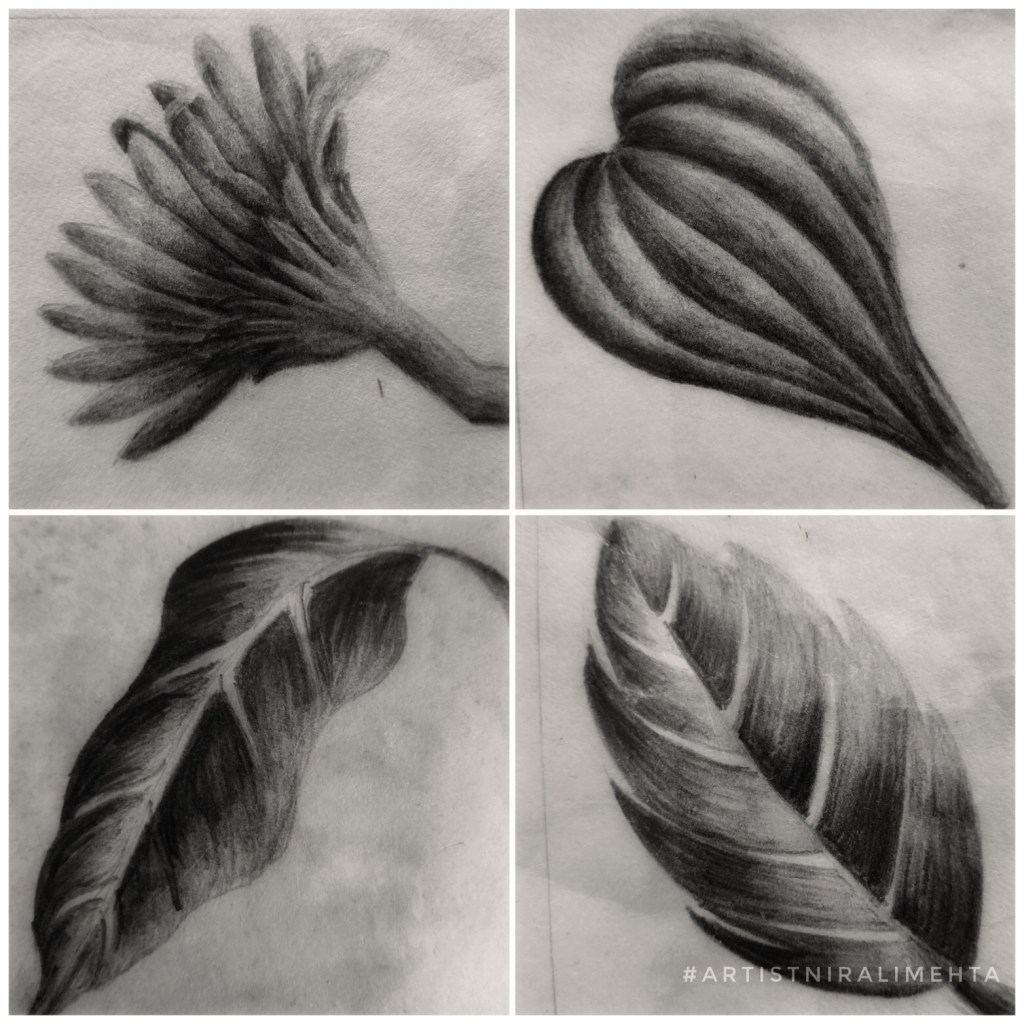
Learning  pencil shading  2
The strokes will improve with time. See bottom images and top images.

Pencil shading is the foundation to a lot of methods in drawing and painting. Once this is aced, the other methods become easier to learn. With time and practice the shading will improve. Like in this picture the leaves in the bottom images are my previous works and then with time it improved as the top two images. All the four are from my early days of learning pencil shading. Then as we feel more confident, we can take up advance levels.

I felt sharing my experience might help beginners taking up Pencil Shading. One can use Coloured Pencils for colouring as well. I have seen artists doing realistic colouring using coloured pencils. One small but important point that I would like to make here is ; with the advent of such amazing digital tools for drawing, even the best artists can get fooled as to whether the art is hand-drawn painted or digital. So please be honest with yourself and learn it without using the digital tools.
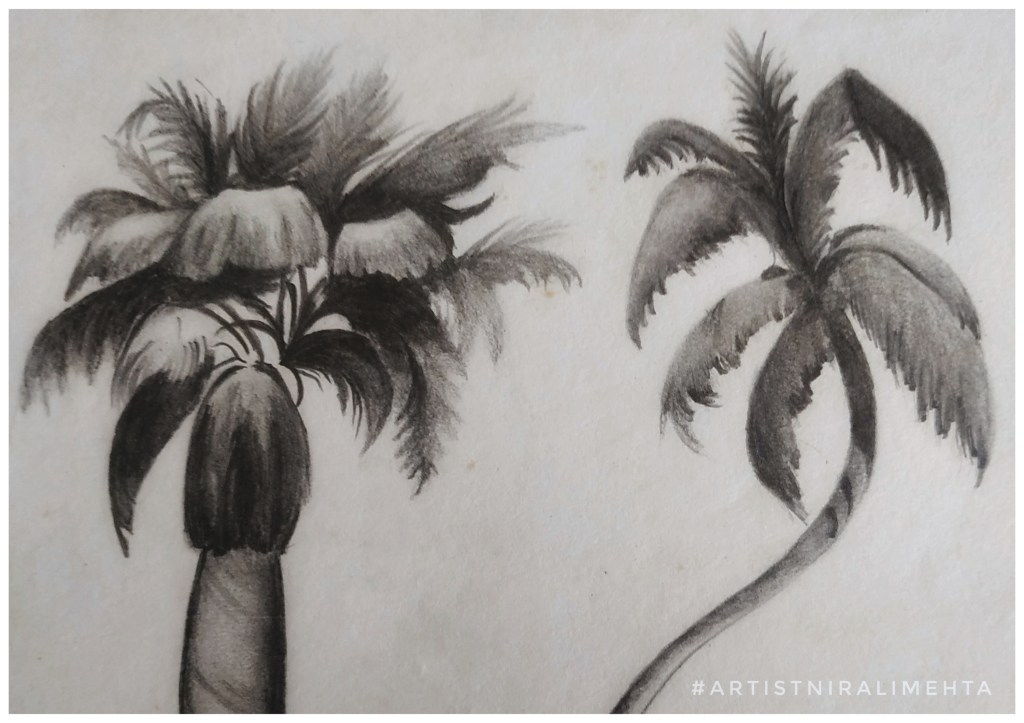
Pencil Shading Trees
Trees done in Pencil Shading

There are some additional things one needs to know about Pencil Shading. Knowing these can sort out some problems that may pop up while learning :-

1) Create strokes or lines to shade in the direction of the object surface. Rounded for the pot. The direction shows the rounded ness of the object. (Picture 9 and10) Some people create bold strokes in pencil shading like this but they should be in the flowing direction of the object. That is how they show movement also.

2) The Paper matters. The thickness, grains and texture of the paper influences the finish. I suggest Cartridge Paper of 160-200GSM if you don’t know which one to go with. After a few trials, you will surely be able to select the paper that works best for your style. (Picture 10)

3) The graphite powder can stick to the hand ruining your work. Keep a plain paper under your hand while shading to avoid this. (Picture 11)

4) All artworks in Black and White look best with contrast. There must be a distinctly dark tone, mid-tone and a light tone in the artwork. The whole artwork could be done using only one pencil. However, there should be areas you can distinctly call dark, mid and light.

Pencil shading tree
The light, mid and dark tones must be clear.

5) For a white, we either erase a portion or leave it as it is. Shade the area around that with a mid or dark tone to give a contrast. (Picture 12 and 13) The white looks whiter when there is a dark colour around.

Pencil shading techniques
Some additional points to note

So let us start! Make smaller objects first and then an entire picture. Think of Pencil Shading as learning the ABC to Art. We don’t need to be professionals at it but we definitely need to know it – Pencil Shading. Have an Arty Weekend!

Related Posts you may also want to take a look at :-

  1. Selecting Pencils for your Art
  2. Five ways to fine tune your Art
  3. Drawing without using a scale or ruler

Drawing without using a Scale or a Ruler

“My son draws well. Look! At five he can draw so well. I couldn’t even draw a circle at his age. Do you think I should encourage him to take up Drawing? Enrolling in classes isn’t happening any time soon. But I don’t want him to waste this time either. What should I do?”

This is a common query I received, more so in the last year. There is a possibility that the parent was not all that good at Art but the child is blessed and talented in Art. With home schooling ‘Art or Drawing’ as a subject is often neglected. The concentration is more on the other book and score subjects. But if your child is good at Art, how can you help him sharpen his skills? Even if you are not very good at it yourself!

Pottery
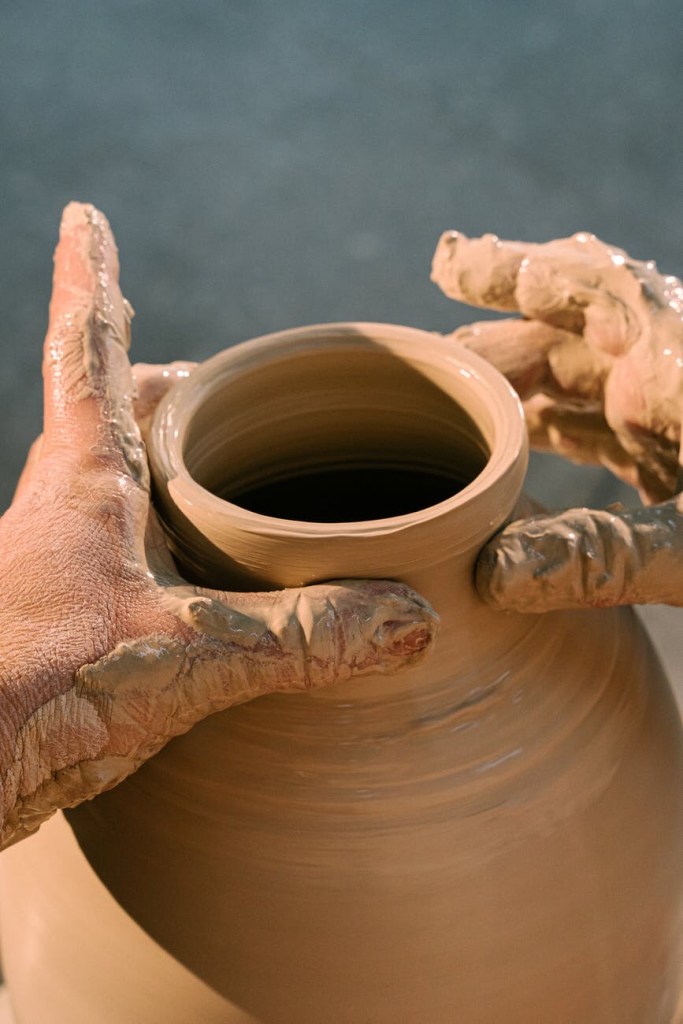
Shaping the earthen Pot

Have you seen a potter make his earthen pots? He shapes them, bakes them and once it’s dry : the shape is fixed, it’s strong and sturdy. It is the same with any sort of training. Same with Art too! We have to ‘train the hand.’ A child’s hand at Art is exactly like that soft mud of the earthen pots that can be shaped. It then becomes important to shape it correctly. Otherwise the pot might not turn out they way you wanted it to, even if the mud was suitable and perfect for making pots. I hope you get the point. Once we learn to draw using instruments we cannot unlearn and draw without them. Most Art schools do not allow the use of scale or rulers or any instruments for that matter.

The most easy access these days is video tutorials on Art. I like them, some of them are really good. My only issue is the foundation. Online tutorials are good for additional inputs or bettering something you already know. On the other hand if you were to learn something you don’t know anything about, I’m afraid the online videos would mean learning in a haphazard manner. Skipping steps and jumping because this system of learning is about convenience and many times they don’t show all the steps.

Besides when we do something by ourselves : we do more of the stuff we like over and over again while we leave out the parts we find difficult. No! Please don’t mistake that as practice. Practice is doing anything we are learning again and again to be better at it.

If you have a good foundation and learn the basics, then learning from anywhere including video tutorials will be very quick and easy. For my calligraphy class we practiced lines and curves for a month, till I got them right. My teacher taught me how to hold the pencil while drawing by actually clasping my fingers and making me do those lines again and again for months until I could draw them fluently.

That comes naturally to me now, like it’s a part of my movement. Just like the hardened earthen pot. My hand has taken shape. No doubt it takes time and practice. And every teacher has a different method of teaching. In this post I am trying to tell you what these foundation materials are. So when your child learns to draw you can make sure they begin from step 1 and build a strong foundation. These things can be taught only in person, so it puts the onus on the parent.

It may be boring but when a drawing teacher makes the child draw lines and shapes for the first few classes, don’t be in a hurry for them to begin drawing actual meaningful stuff. It’s like running even before your learn to walk. First learn to stand, then walk and then run. In the same way draw lines, curves, shapes neatly in clear strokes. In future for anything we draw we first draw rough lines and curves and then the final shape.

Pro Tip here: Use a 2B pencil slightly blunt to draw. Use a regular pencil and not the pen-pencil or changing points fancy pencil as your first drawing pencil. Even if you use them select a 2B lead. HB lead is for writing dark and legible- not for drawing. Strokes drawn with a 2B pencil are light and can be erased easily.

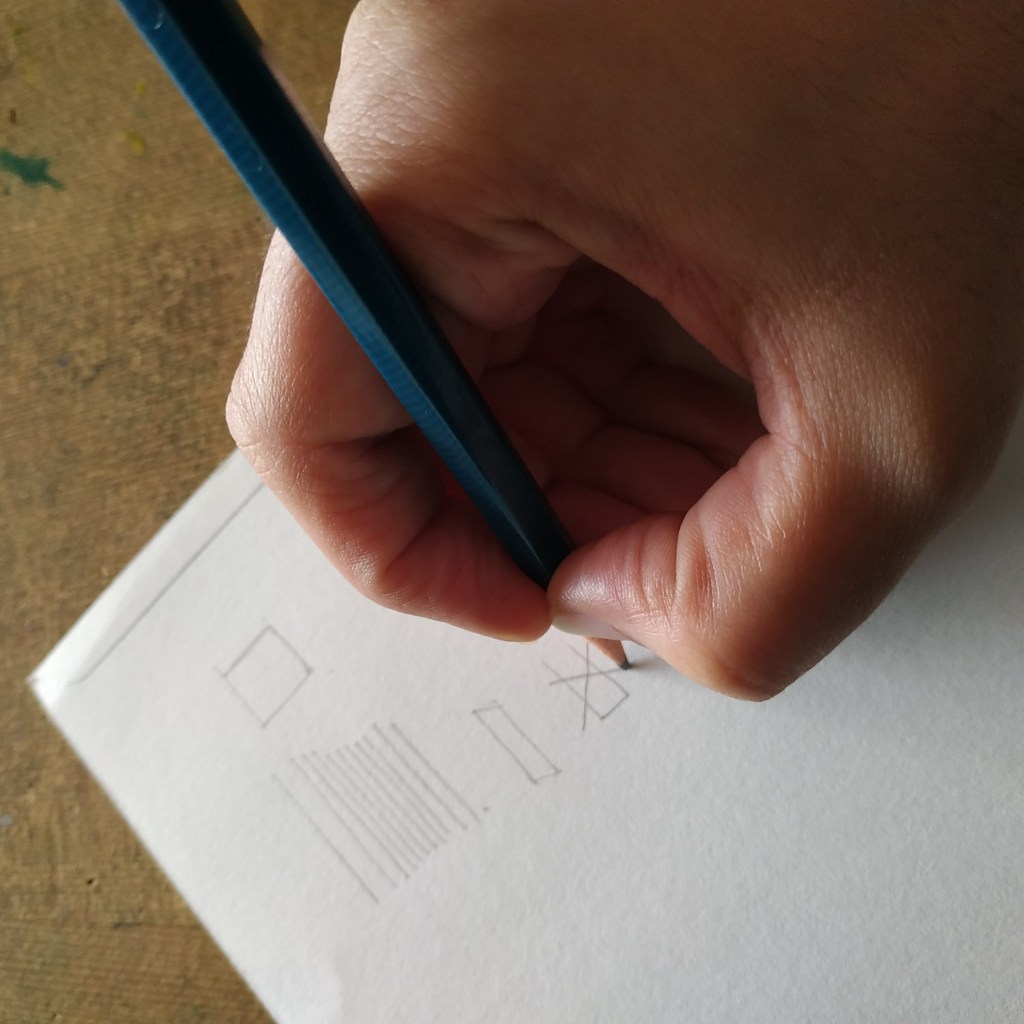
Learn to draw 1
Pic 1 : Holding the Pencil and Drawing lines
Learn to Draw 2
Pic 2: This is to write. Wrong way to hold for Drawing

Consciously make a note and see how you hold the pencil when you draw. Holding it like shown in the second picture will give hard dark lines that are difficult to erase and restrict movement for large strokes. Try it! While in the first one you will be able to move the pencil freely, drawing long lines in a single stroke without lifting the pencil. We can also see what we are drawing. Can draw by lightly touching the paper and strokes can be erased without leaving any marks.

Learn to draw 3
Pic 3: Drawing different Shapes

Practice drawing different shapes. Here in one of the pictures I have drawn the axis and then the circle showing a glimpse of how we use reference lines for drawing. Next to that is circles directly drawn. The axis have to be straight because the rest of the drawing depends on it. Further most drawings are combinations of basic shapes. Practising these ensures training the hand for free movements to draw.

Learn to draw 4
Pic 4 : Drawing a straight line with help of edge

I am holding the pencil differently to draw this border without the use of a scale. It measures to about half inch border on all sides. I take the help of my drawing board or book edge to lock my fingers and steadily draw a line parallel to it. Warning!! Please be careful the edge of a new paper is sharp enough to cut your hand. Try this only under supervision of an expert.

This is about drawing lines without using a ruler or a scale. Below I am showing ‘How to measure and draw symmetrical drawings without using a ruler or scale’ or any other measuring instrument.

Pic 5 : Drawing Symmetrical Objects

I am using the drawing pencil to measure and make markings to draw a symmetrical object. Here one half side is drawn and I have to match the other side to complete the object. Following the steps :-

  • Half side is drawn and I have made axis at major turning points.
  • Measuring the distance of the intersection point on drawn side with the pencil.
  • Making the same intersection markings on the other side.
  • See all the marked points. Can make points for the length and width as required.
  • Join all the points to match the drawn half.
  • Erase or add markings and corrections till they look visually same.

This method of measuring is also used while drawing live in person. That is when the subject you are drawing is in front on you. When we draw from a picture we make a similar grid and then match points to draw alike. They say the measuring tools are in the eyes of the artist. However not everyone is so good at it and so these other methods can be helpful.

Drawing this vase also demonstrates how we use lines and curves while drawing. These are basics and the foundation to drawing. Once you learn to draw like this, I am sure you will be able to draw most of the things. Have an Arty Weekend!

Pencil Mania – Part 1 ; Selecting the right pencils for your Art

Ever gone to an Art store and wondered ‘To buy or not to buy’ that is the question! And if you go with your kids, they will want to buy everything they can see on that shelf. Hehe..it happens with all of us. However it is not practical to stock so much. Also, it may end up being a waste of money or material. We all want to buy tons of Art Supplies especially when the display is so attractive. So then how to keep both your art appetite and your pocket happy at the same time? Knowing your Art Materials might help make an informed decision and select a product suitable for you.

This time I’m doing an article on the different Pencils you can use for your Art. I will cover all the type of Pencils available in the market and their use. I do not endorse any brand and hence will not mention any names, just how to make your selection based on your understanding of the product. This is not a product review but a know your Art Materials post. Based on my experience of using these, I will share a few special tips too!

Graphite Pencils: Graphite or Lead encased in a cover of plastic, paper or wood. The lead is used for drawing or writing. We all know that right! These are available in different grades depending on the hardness or softness of the lead. Here in India, we use an HB pencil most often for writing. The Pencils I use for drawing and shading or sketching are 2B, 4B and 6B. ‘B’ stands for blackness while ‘H’ stands for hardness. The pencil grades meter will show this. Higher the number, darker the pencil finish, softer the lead better for shading and smudging. You could go for the ready set or buy only selected ones as per your requirement. I prefer buying single pieces because I don’t use the other grades, so for me it is a waste to buy the entire set. Further if I use up a lead faster than the other, I keep more of those. I buy more of 2B pencils and maybe just one 6B pencil. You could do the math and in all probability it will even turn out more economical also. Just these three pencils is enough at the beginners level and even on a professional level. Once you take up pencil shading commercially or professionally you may want to invest in a complete set of any good brand suitable to your use.

Coloured Pencils: Coloured Pencils are made of a Pigment (colour) and a binding agent that binds this coloured powder. There are three types of coloured pencils based on the material they are made up of – wax based, oil-based and water-soluble. A pencil that has vibrant colour, a soft but strong lead that presses the colour well on to the paper but does not break easily while making bold strokes is considered as good quality coloured pencil. These are generally bought in a set. More the number of shades, more fun for an artist to colour the picture. 24 or 48 colours is considered a large variety but you even get up to 150 shades in a box for professionals. It is a one time investment because one box can last you for years unless you misplace a few shades. Rarely can one run out of a shade because they used it all up.

Waxed based coloured pencils have a soft lead and are slightly difficult to blend as compared to the others. I prefer oil-based coloured pencils – the lead is soft but sturdy, remains sharp, doesn’t dry out fast, pigments are nice, layering and blending can be done easily. Actually even for crayons I prefer Oil Pastels. So actually it is like the same family and works well if you use different mediums in the same Artwork. Wax based coloured pencils are less expensive than the others.

Water Soluble or Watercolour Pencils or Aquarelle Pencils : As the name suggests are water based. They can be used dry or wet. The dry version gives a lighter colour but once you use water over it, it gives an almost watercolour like finish. Once you paint something, you use a plain water brush over it and blend the strokes. Washable with water or removable, you can use these to shade or highlight in your watercolour paintings. We even get water soluble ink pens or watercolour brush pens. This combination works for those who do watercolour paintings.

We cannot use a water based colour on an oil based colour or a wax based colour. However we can use a wax based or oil based colour on a water based colour. Many people use wax based and oil based interchangeably. An important point to note here is that all three types are not manufactured by all brands. This is their point of differentiation. It means a difference in price, quality and finish. Reading up a little about the brand and which type of pencils they offer will surely help in making your selection.

Further like all Art materials even Coloured Pencils are available in two categories :-

1) Artist Quality 2) Student Quality

Most brands offer both. An Artist Quality will have better colour quality meaning more pigment less binder and will be more expensive than the student quality. So check the label and buy as per your usage. I generally prefer buying Artist Quality even if it lesser number of shades. For a school going child you may want to buy Student quality just in case the child misplaces or breaks them. The price difference can be substantial at times.

Many people feel coloured pencils are for children. That isn’t true. Adult Colouring is trending. It is a stress buster and many Adults are taking to colouring these days. Adult colouring means the colouring pages will have pictures with details or smaller colouring blocks as compared to colouring books for children which have pictures with a larger colouring blocks. There are ample colouring pages and books available in the market. Sometimes they are free. It is a good way to pass time while travelling too!

I will share about other Art Pencils – Charcoal, Pastels, Woodless Pencils in my next post. Have an Arty Weekend!