Drawing without using a Scale or a Ruler

“My son draws well. Look! At five he can draw so well. I couldn’t even draw a circle at his age. Do you think I should encourage him to take up Drawing? Enrolling in classes isn’t happening any time soon. But I don’t want him to waste this time either. What should I do?”

This is a common query I received, more so in the last year. There is a possibility that the parent was not all that good at Art but the child is blessed and talented in Art. With home schooling ‘Art or Drawing’ as a subject is often neglected. The concentration is more on the other book and score subjects. But if your child is good at Art, how can you help him sharpen his skills? Even if you are not very good at it yourself!
Pottery
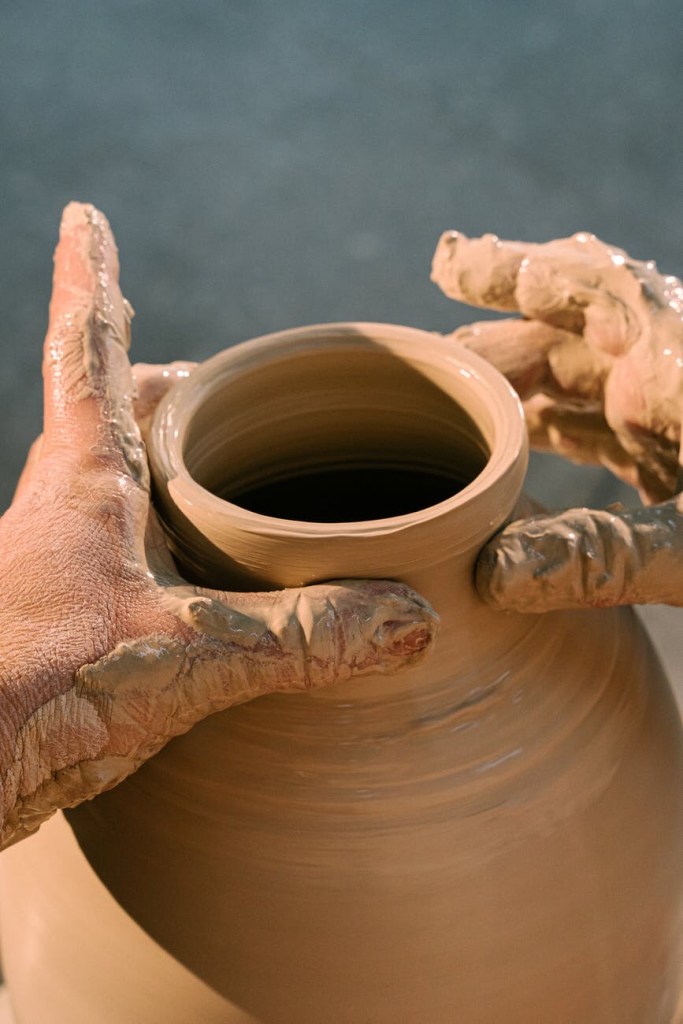
Shaping the earthen Pot

Have you seen a potter make his earthen pots? He shapes them, bakes them and once it’s dry : the shape is fixed, it’s strong and sturdy. It is the same with any sort of training. Same with Art too! We have to ‘train the hand.’ A child’s hand at Art is exactly like that soft mud of the earthen pots that can be shaped. It then becomes important to shape it correctly. Otherwise the pot might not turn out they way you wanted it to, even if the mud was suitable and perfect for making pots. I hope you get the point. Once we learn to draw using instruments we cannot unlearn and draw without them. Most Art schools do not allow the use of scale or rulers or any instruments for that matter.

The most easy access these days is video tutorials on Art. I like them, some of them are really good. My only issue is the foundation. Online tutorials are good for additional inputs or bettering something you already know. On the other hand if you were to learn something you don’t know anything about, I’m afraid the online videos would mean learning in a haphazard manner. Skipping steps and jumping because this system of learning is about convenience and many times they don’t show all the steps.

Besides when we do something by ourselves : we do more of the stuff we like over and over again while we leave out the parts we find difficult. No! Please don’t mistake that as practice. Practice is doing anything we are learning again and again to be better at it.

If you have a good foundation and learn the basics, then learning from anywhere including video tutorials will be very quick and easy. For my calligraphy class we practiced lines and curves for a month, till I got them right. My teacher taught me how to hold the pencil while drawing by actually clasping my fingers and making me do those lines again and again for months until I could draw them fluently.

That comes naturally to me now, like it’s a part of my movement. Just like the hardened earthen pot. My hand has taken shape. No doubt it takes time and practice. And every teacher has a different method of teaching. In this post I am trying to tell you what these foundation materials are. So when your child learns to draw you can make sure they begin from step 1 and build a strong foundation. These things can be taught only in person, so it puts the onus on the parent.

It may be boring but when a drawing teacher makes the child draw lines and shapes for the first few classes, don’t be in a hurry for them to begin drawing actual meaningful stuff. It’s like running even before your learn to walk. First learn to stand, then walk and then run. In the same way draw lines, curves, shapes neatly in clear strokes. In future for anything we draw we first draw rough lines and curves and then the final shape.

Pro Tip here: Use a 2B pencil slightly blunt to draw. Use a regular pencil and not the pen-pencil or changing points fancy pencil as your first drawing pencil. Even if you use them select a 2B lead. HB lead is for writing dark and legible- not for drawing. Strokes drawn with a 2B pencil are light and can be erased easily.

Learn to draw 1
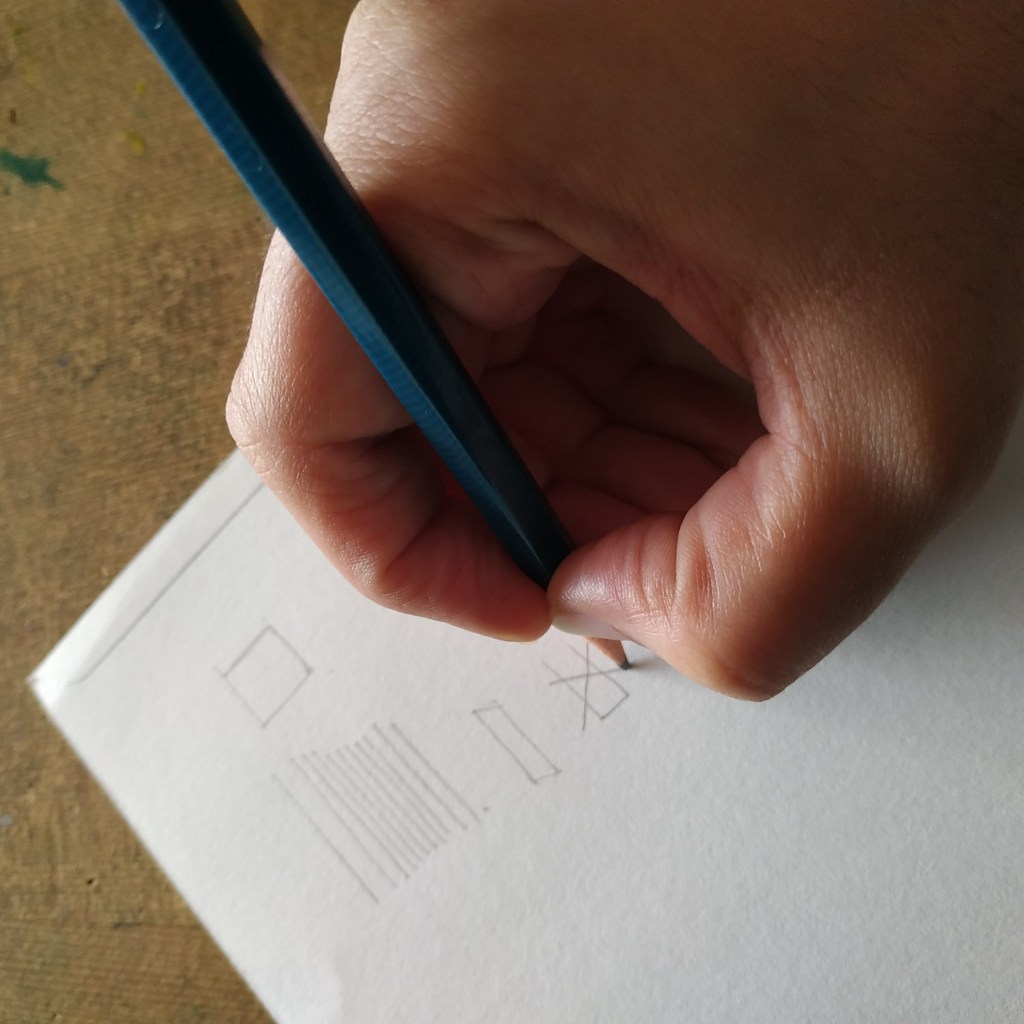
Pic 1 : Holding the Pencil and Drawing lines
Learn to Draw 2
Pic 2: This is to write. Wrong way to hold for Drawing

Consciously make a note and see how you hold the pencil when you draw. Holding it like shown in the second picture will give hard dark lines that are difficult to erase and restrict movement for large strokes. Try it! While in the first one you will be able to move the pencil freely, drawing long lines in a single stroke without lifting the pencil. We can also see what we are drawing. Can draw by lightly touching the paper and strokes can be erased without leaving any marks.

Learn to draw 3
Pic 3: Drawing different Shapes

Practice drawing different shapes. Here in one of the pictures I have drawn the axis and then the circle showing a glimpse of how we use reference lines for drawing. Next to that is circles directly drawn. The axis have to be straight because the rest of the drawing depends on it. Further most drawings are combinations of basic shapes. Practising these ensures training the hand for free movements to draw.

Learn to draw 4
Pic 4 : Drawing a straight line with help of edge

I am holding the pencil differently to draw this border without the use of a scale. It measures to about half inch border on all sides. I take the help of my drawing board or book edge to lock my fingers and steadily draw a line parallel to it. Warning!! Please be careful the edge of a new paper is sharp enough to cut your hand. Try this only under supervision of an expert.

This is about drawing lines without using a ruler or a scale. Below I am showing ‘How to measure and draw symmetrical drawings without using a ruler or scale’ or any other measuring instrument.

Pic 5 : Drawing Symmetrical Objects

I am using the drawing pencil to measure and make markings to draw a symmetrical object. Here one half side is drawn and I have to match the other side to complete the object. Following the steps :-

  • Half side is drawn and I have made axis at major turning points.
  • Measuring the distance of the intersection point on drawn side with the pencil.
  • Making the same intersection markings on the other side.
  • See all the marked points. Can make points for the length and width as required.
  • Join all the points to match the drawn half.
  • Erase or add markings and corrections till they look visually same.

This method of measuring is also used while drawing live in person. That is when the subject you are drawing is in front on you. When we draw from a picture we make a similar grid and then match points to draw alike. They say the measuring tools are in the eyes of the artist. However not everyone is so good at it and so these other methods can be helpful.

Drawing this vase also demonstrates how we use lines and curves while drawing. These are basics and the foundation to drawing. Once you learn to draw like this, I am sure you will be able to draw most of the things. Have an Arty Weekend!


5 Ways to Fine Tune your Art – Drawing, Painting and Sketching

Ever looked at your finished Art and thought something is missing. Somehow I am not completely happy with it. There could be something to improve but I just don’t know what? Further sometimes we don’t even know where to look, which part of it needs to be fine tuned. If we work on one portion, something else looks out of place. I know this feeling, it happens.

So do you know how to get it right? That is the question I am going to try and answer in this post. In this article when I say Artwork: it means Drawing, Painting and Sketching. And when I say object- it refers to whatever we are drawing, painting or sketching. I don’t have a checklist of any kind but I can definitely tell you the five ways to fine tune your Artwork in order to improve and make it better based on my learnings and experience.

These are also the observations we need to make when doing Art. If you observe these and are able to check them right, not only would you be good at Art but also find it easy to understand and learn different Art styles. This is more or less an exhaustive list. It does have sub topics or points. In a way it is also 5 mistakes to avoid while making Art.

It is like a grade meter, how much fine tuning is required for each of the parameters will have to be determined by you. That is because it is to your taste. Over a period of time with observation and experience you will be able to decide your own parameters for each of these. Perfection isn’t when all of it is present, it is when all of it is in the right quantities. So let’s begin listing them.

1. Shapes and Patterns

Everything has a main outer shape and maybe more smaller shapes. It is important to observe this. First we draw this main shape and then do the details. Consider it as rough work to your final answer. This also helps decide the placement for various objects in the Picture. You can also take them as a marking of the space each object can take on the canvas. It is important to place things evenly or rather correctly space them out on the canvas. Most people make the mistake of skipping this step and begin to draw directly.

Let’s consider drawing something like ‘My House’. If you are drawing this landscape, make the large main shapes of the tree, the fence, the house, the sun or sky, the human with his pet, the ground and so on. Then add the details. Erase the rough work. It is the correct method to draw.

Some videos on the Internet will show super awesome Artists who complete one particular corner of the art with full finished details while the rest of the canvas is blank. Wow! They are super humans but we are normal humans and this is how we draw. It is mostly a digitally edited video, very rarely can anyone draw like that. They need to get into the book of records for such exemplary skill if they really can. For the rest of the normal people this is the first step for drawing anything.

Everything in nature has a pattern. So for example when you draw a flower. Look for this main shape of a circle or an ellipse. See the pattern of the petals are they – above or below, in odd numbers or even. See the shape of the petals – pointed or round, long or circular. Further see the centre of the flower and look for a shape there. The pollens will have a pattern – are all of them in the same direction, how many turn right or left. These things we need to observe and then when we draw, we match it with our reference.

2. Proportions and Scale

Many people confuse these terms. So in another words it is the size and ratio of the objects drawn. So in your landscape a bird cannot look bigger than the tree, that is scale. Now how much space of the tree is the branches and how much the leaves – that is proportion. That is what we need to observe. How the object looks in context with the other objects in the picture and what are the proportions of its own parts. When drawing a human face you would note the proportion of the eyes to the eyebrows, the nose and lips. The scale would be the size of the actual face. They are connected and not used in isolation.

3. Perspectives and Backgrounds

Which angle or point are you looking at it from? Top or bottom, right or extreme right. The distance- up close or far away. The objects which are closer are detailed, while the objects farther away at a distance in the background may not have all the details. If you draw details of all the objects in a picture, it is like keeping everyone in the front row. It will look like everyone is shouting for attention. The focus is always on some objects in the front and less on those in the background. Artworks with backgrounds look complete.

Perspective adds depth. The third dimension or 3D. This makes the object look natural as against flat image. 3D means 3 axis – X axis, Y axis and Z axis. Length, width and depth or thickness. The most common example is if you draw a rectangle. Now try imagining this as a box, as that of the wall of a house or this wall Humpty is sitting on.

Your position while looking at the object determines how it is visible to you. For example four different people looking at a car from four different spots – the top, from the right, the left and the bottom will all draw it differently based on what they see. Correct? What your view is, is your perspective. This brings about a balance in the picture.

4. Light, Shadows and Highlights

In one picture there can be one source or two sources of light. Two when there is one natural source like the Sun and two when there is a light fitted or the created source. The light coming from any point does not fall equally on all the objects. The rays fall in a straight line and not in curves. So the whole picture has be in sync with it. The Shadow of an object is determined by the direction of the light and also falls straight. Depending on the position, the size of the shadow will change. There could be a situation where the shadow of one object also falls on another.

There is something called highlight – when a significant portion of the light falls at a spot and it almost looks white. We colour or shade from light to dark or dark to light and then add the shadows and highlights. This adds depth to the painting. Also observe how an object reflects the light. The texture and surface of the object determines that.

It really looks funny when all objects have different sources of light and random shadows. There has to be a flow in the picture.

5. Colours, Shades and Tones

Tones is Dark, medium and light. This is determined by the source of light in your picture. When you do an artwork in black and white it will still have these. The gradient is smooth and blending it is important. Where we want to show it as blocks, we make sure the edges are crisp. When we colour the objects, we can try as much as possible to match the exact colour to the real object. Mixing of colours to make various tints, tones and shades can be understood with the help of the colour wheel.

There should be a contrast between the dark, medium and light tones otherwise the image will look flat. Meaning how dark the colour looks against the medium tone colour. Whether the difference is significant or very little. Sometimes all you need to do is make the dark shade a bit darker. A pro tip here is not all colours can be made lighter by adding white or darker by adding black. When you observe an object see the dark colour, does it have traces of other shades. For example the dark colour could be brown with little of green and not always necessarily black.

These topics need to be studied in detail. The only way to understand these is to observe and try it out practically. Now that you have basic information about these, the next time you are drawing, sketching or painting look and observe these things in your Artwork. Whatever you are drawing – be it a portrait, a landscape, an object, nature or design. Check for these and mark the difference with your Art as against your reference. Your artwork will show significant improvements.

If possible, take an object like a flower or a vase or a pen or a bottle or a landscape picture, keep in it front of you and then read this article once again while observing these and mentally making a marking of each. Then begin to draw. It isn’t a one time exercise, you keep going back and forth. I am sure you will be pleased with the outcome. There is a possibility that after years of practice some artists can do a mental calculation of these. After all Art is about being able to imagine that object on your canvas, so that you can draw and paint it.

Have an Arty Week!

Year in a Review

In the Holiday mood, I am also going to take a break next week. Most people have already signed off till New Years. As a shop owners, we are busy making products, posting on social media, settling accounts, packing, shipping and making new and the cycle continues year round. That makes us use our phones for long hours at work. A little digital detox to spend time with yourself, family and nature can rejuvenate us.

My Desk
My Desk! It’s Christmas 🎄

And we can come back in the New Year refreshed and charged up for another year ahead. Many people also use this time to upgrade their skills, read up on books they always wanted to. I started my Blog this year in September 2020. I have 17 Posts by now. The response to the Blog has been overwhelming. It’s been a good journey with your love, support and encouragement.

So I thought I would do this year in a review post. Helps me connect with the new followers too! Here is a list of the posts I have done on Arts and Crafts so far. You may click on the title to go to the post. All these are listed on my Blog page – ‘The Art Life’

So just in case you missed out on reading any of them, you still can. Please note the Blog page shows only the last 10posts and so to see the previous ones you may use the links above or scroll to previous posts.

If you like reading my posts and wish to continue our association, you may click follow or subscribe to the Blog. This will make the posts come to your Email Inbox and you may read them at your convenience.


Wishing everyone a Merry Christmas and a Happy New Year!

December Calendar with a Christmas Wreath that I created Digitally

This is an Instant Digital Download (JPEG) File that can be purchased at my Etsy Shop NMARTWORKS Picture Format opens with any Photo Editing Software. Once you pay, you can instantly download and use.

Let’s make Greeting Cards with ease

My Niece gave me a handmade Greeting Card recently. It felt so nice to know that someone thought of me and made me something special. I feel giving someone a handmade Greeting Card adds a personal touch. With the festive season approaching I thought it would be nice to share a simple and easy method to make a handmade Greeting Card using Ink Pens and Watercolours. I have shared two designs but you can always be creative and add your special touch to it. You can do traditional designs or even contemporary illustrations with the same technique.

First let us collect the Art Material that we will need :

1) Pencil and Eraser – I usually use a 2B pencil and a regular eraser

2) Ink Pens of any good brand with Waterproof Inks or Archival Inks – Waterproof will be written on the pens. These are available in different tips ; sizes, colours and brushes. A notable feature of these pens is that once the ink dries, you can easily use watercolour over them. It won’t smudge.

3) Drawing Paper or Card Paper with a minimum thickness of 180 – 200GSM. Basically a paper suitable for Watercolour Paintings. A notable feature here is that the paper absorbs the water and doesn’t peel off with use of water. Ideally 300 GSM is very good for Watercolour but it is too thick to fold for a Greeting Card.

4) Watercolours (Any colour; Tubes or Cakes) and Brushes

5) Compass, Ruler, Protractor and/or other Measuring Tools (Optional)

The process:-

1) Draw your design using the measuring tools in Pencil.

2) Use a pen with a thin tip like ‘005’ or ‘01’ and outline the Art. Do only the main outline. Don’t fill in the details yet. The idea is to block the main markings which will assist when you paint after doing the background. If you are very confident you can directly paint after the background but for most people these markings make it neat and easy.

3) Erase the extra pencil markings.

4) Use watercolours and shade the background with colours of your choice. Kindly avoid gouache paint or thick paint, it will make the steps listed below difficult.

5) Let it Dry completely. I list this as an important step. This is so that your pen tips do not get spoilt with moisture or excess colour that isn’t dried yet. It is the same reason I asked to avoid thick paint.

6) Now paint the details to your Design using the waterproof ink pens. This will be the final look.

Step by Step DIY Greeting Cards

You may use colour pencils, coloured pens and embellishments to add some aesthetic touches to your work. There you go! Last but not the least write your personal message and our beautiful handmade Greeting Card is ready! Wishing everyone a very Arty Weekend!

Pro Tip – You may also combine this with Paper Quilling and Stamping.

My first Art

“What is the easiest drawing to begin with? I want my child to learn drawing, where and what should I start with?” This is a question I am asked often. In this article I will share two different drawings that are simple and easy for a child to begin with. These were the first pictures I learnt to draw and colour as well. Yes! I said colour and not paint. That brings me to the selecting the Art material.

Paper: Use large sheets. Drawing a small circle for an adult is often a big circle with the movement of hand for children. They tend to fill up colours better in larger drawings. Further use a sheet of paper that is prone to high erasing. I often used box board (white duplex board) sheets as my drawing paper during my earlier days of learning.

What else do I need? A good pencil and a good eraser. A new pencil that is big is better for grip. If they are still learning to hold a pencil it is all the more important to have a pencil the child would be comfortable using. Use a slightly rounded tip pencil, meaning don’t sharpen it to a very pointed tip. This would ensure the paper doesn’t have dents after erasing the extra lines. Now for the Colours – I recommend using Oil Pastels. I didn’t say crayons nor did I say paint. Oil pastels of any good brand but a large number of colour shade options. The more colourful picture they can make the better. Since they don’t know much about mixing shades, having more shades in the colour box helps the child make a nice attractive drawing. Now that you are ready with the materials let’s decide a topic.

1. Under the Sea

2. My Home

Under the Sea Drawing for Kids
My Home drawing for kids

I have shared a drawing for each topic. You may use it as a reference or idea to begin with. Once the pencil sketch is ready, colour it in your own way. Sounds easy! So let’s begin to draw 😀 Do share your finished Art piece with me, I would be happy to see it.